


Why the stock market keeps finding its footing
Despite geopolitical risks, strong fundamentals, steady earnings and persistent demand from retirement flows continue to support stocks
Lectura de 5 minutos
PUNTOS CLAVE
- Solid earnings, healthy margins and a stable labor market suggest the U.S. economy remains on firm footing.
- Equity demand continues to outpace supply, driven by a shrinking pool of public companies and the growing dominance of large-cap stocks in index investing.
- A steady stream of retirement contributions into defined contribution (DC) plans creates a powerful, long-term tailwind for equities, reinforcing market resilience.
As we continue to see an uneasy, and uneven, path towards a resolution in the Iran conflict, the stock market has quickly rebounded to all-time highs in the S&P 500 and NASDAQ. Skeptics point out the risk of a re-escalation, which would introduce the potential for more widespread and, therefore, longer-lasting, damage to energy and civilian infrastructure. That risk is there. Yet, looking beyond the conflict and its impacts, which, if resolved, will be shorter-term in nature, the underlying momentum within the domestic economy remains positive.
Earnings expectations are firm, corporate margins are healthy, credit spreads remain contained, weekly jobless claims remain low and the overall unemployment rate stands at 4.3%. We can almost always point to potential trouble spots-such as private credit, auto loans and credit card delinquencies-and we know headline inflation is going to show upward pressure for the next few months, but in aggregate, there is more good than bad, and the capital markets reflect as much.
Another important factor at play is much more basic from an economic standpoint: simple supply and demand. Our chart this week shows capital flows into exchange traded funds (ETFs) as a proxy for broader flows into the stock market. After dipping in March as the conflict in Iran broke out, ETF flows quickly rebounded and are now above levels seen before the conflict. ETFs' growing popularity has led to increased flows into them; still, looking at overall flows into equities reveals a similar picture: a steady underlying bid for equities. Where is this drive coming from?
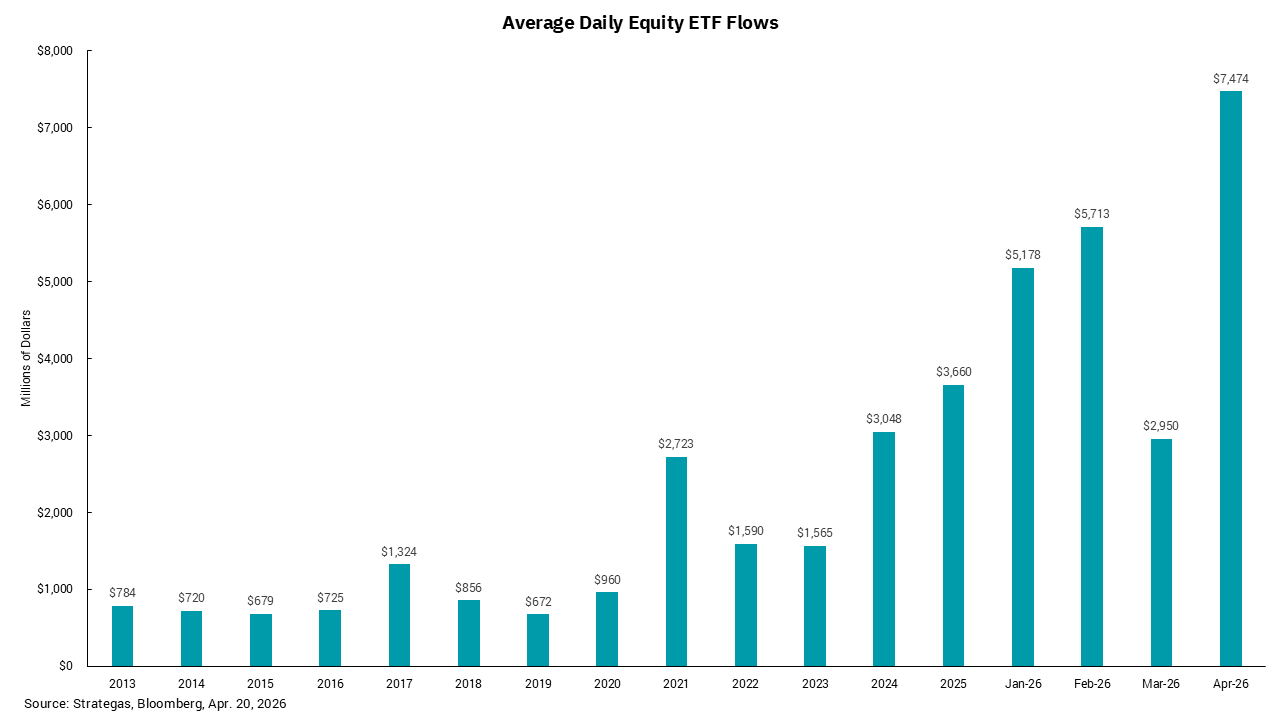
Let's start with the supply side of the equation. After peaking in 1996 at 8,090 publicly traded companies, the following decades have seen a steady decline to just over 4,000 companies today. We also know that the size of the companies at the top of the market continue to get bigger with the top 10 companies in the S&P 500 making up more than 40% of the market value of the index overall. As passive index investing has grown in popularity, the bigger companies continue to get an increasing share of the capital flowing into the market. The total market value of publicly traded stocks is approximately $60 trillion.
This leads us into the demand side of the equation. Over the last 30 years we have seen a significant shift towards defined contribution (DC) retirement plans and away from defined benefit (DB) retirement plans. Recent data from Vanguard shows 100 million Americans have a DC plan balance. Total assets within these DC plans are now more than $12 trillion. With average deferrals by participants at 7.7% and an average company match of 4.6%, total annual deferrals are now over 12% of these participants' salaries. In 2022 the Department of Labor showed total DC contributions of $791 billion, though more recent data would probably have this number approaching $1 trillion annually.
Now, all this money is not going into stocks. Some of it is going into bonds or even staying in cash, but much of it is going into target date funds. Assuming the longer-term nature of retirement savings, we can reasonably assume most of these funds are flowing into equity products. In fact, even if we assume that only half of these retirement contributions flow into equities, that represents between 8% and 9% of total market value going into the equity market every year. This steady, and growing, underlying bid is one important reason gravity in the stock market is higher.
Obtenga By the Numbers en su bandeja de entrada.
Suscríbase (Se abre en una pestaña nueva)